

Synthesis Session
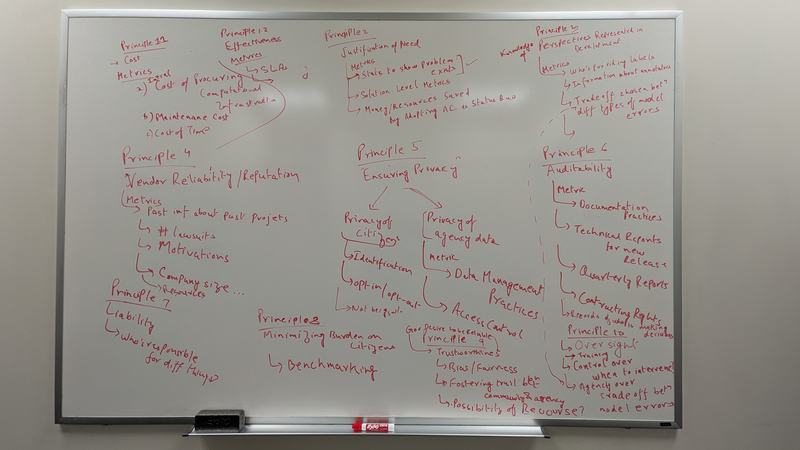
Following the breakout sessions from day 1 discussions, insights from each group were collected and discussed collectively in a larger synthesis. During this process, participants compared observations across groups and identified recurring themes in the types of information that were missing from existing AI fact sheets. While current fact sheets often provide technical performance indicators and general statements about responsible AI practices, they frequently lack measurable indicators related to governance, accountability, and social impact.
To organize the ideas generated during the synthesis discussion, participants collectively developed a conceptual framework consisting of four meta-principles that reflect the dual responsibilities involved in public-sector AI procurement. These meta-principles consider both benefits and potential harms across two key stakeholder groups: government/NGO AI procurers and the citizens who may be affected by the deployment of AI systems. The four meta-principles include maximizing benefits to procurers, minimizing harms to procurers, maximizing benefits to citizens, and minimizing harms to citizens.

Within this framework, participants proposed a range of principles and associated metrics that could support more informed procurement decisions. For example, maximizing benefits to procurers includes evaluating the costs of adopting and maintaining AI systems, ensuring there is a clear justification for adopting the technology, preserving the agency of government decision-makers through mechanisms such as human-in-the-loop oversight, and assessing the overall effectiveness of the AI tool. Minimizing harms to procurers focuses on considerations such as vendor reliability, the ability to audit system behavior, and clearly defined liability frameworks in cases where the system produces harmful outcomes.
The framework also highlights considerations related to citizens. Participants emphasized the importance of minimizing unintended burdens on individuals, including potential biases in system outputs and the lack of recourse mechanisms for those affected by automated decisions. Privacy protections and transparent data management practices were also identified as key concerns. In addition, participants discussed the importance of understanding the perspectives represented in the development of AI systems, including the positionality of developers and data annotators, as these factors may influence the biases embedded in the system.
Together, these discussions illustrate that effective AI procurement requires documentation that extends beyond traditional technical metrics. By incorporating considerations related to governance, accountability, and societal impact, the proposed meta-principle framework aims to support more responsible and context-aware decision-making when governments and NGOs evaluate AI technologies for deployment.